


Happy New Year 🎊 2026 has begun, and with it, my resolve to say ‘yes’ to more scary things! On that note, for my first post of the year, I’m returning to one of my first scary ‘yes’ ~ 🇬🇷
Sometimes, you need a makeshift book club with your friends to get you to read something that’s been on your TBR list for eons. As such, earlier this semester, I made headway into Emily Wilson’s wonderful translation of The Odyssey. This, combined with my newfound love for EPIC the Musical, reminded me that I have yet to write Part 2 of my own Greek adventure.
Island of Many Names
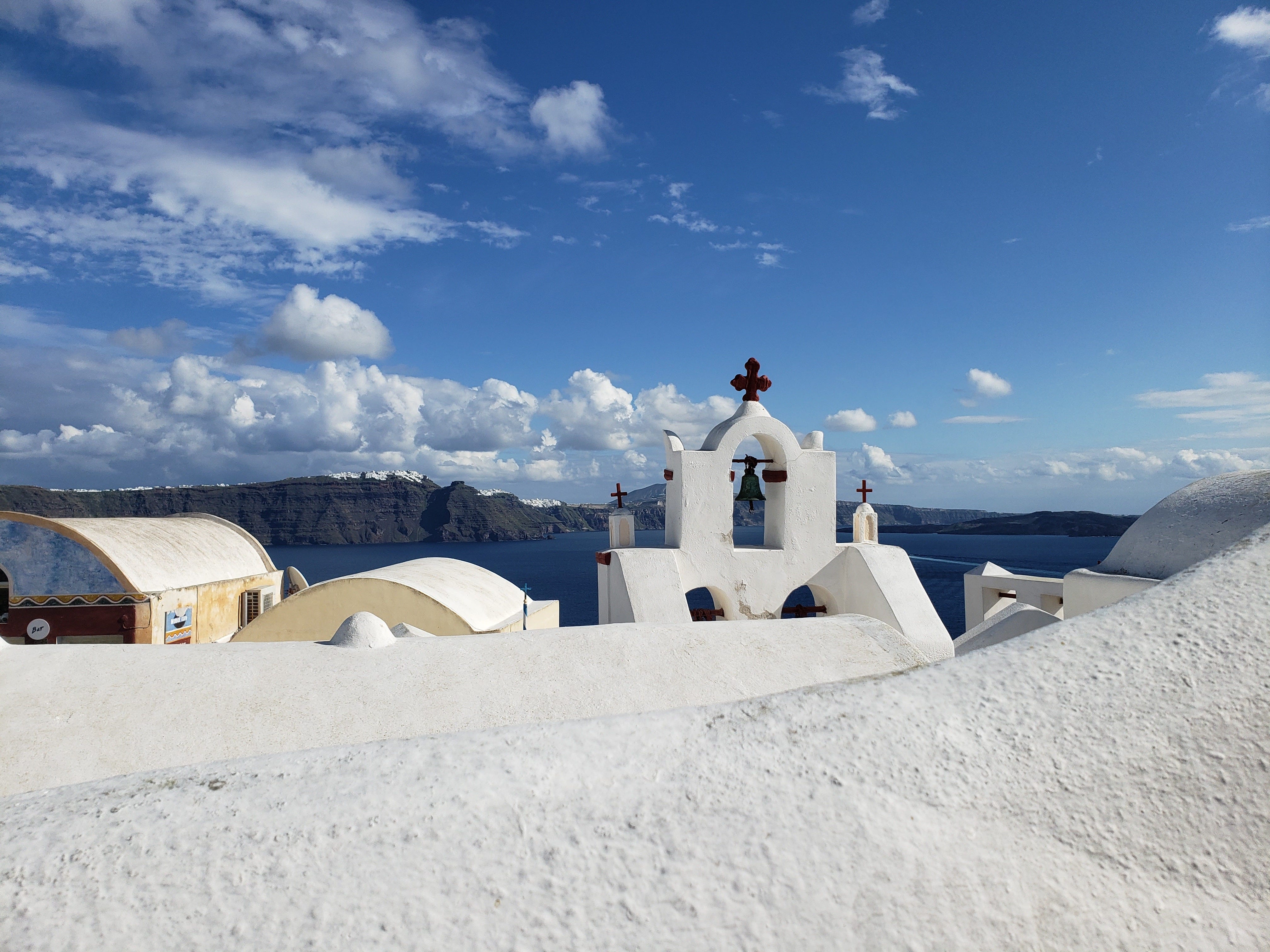
Strongili, Kalliste, Thera – Santorini has been known by many names throughout its loooooong, rich history. Although today it is mostly famous for the gorgeous white-and-blue city of Oia, it is also home to the ancient site of Akrotiri and a spectacular archaeological museum that does not get enough attention (in my opinion). From Crete, we (my friend, roommate, and travel-buddy Liz and I) boarded a plane for our next stop on the class itinerary, and one-airport-mishap-in-Athens later (the aircraft was deemed unsafe, so they herded us around the tarmac until they found one bound for the island), we finally made it!
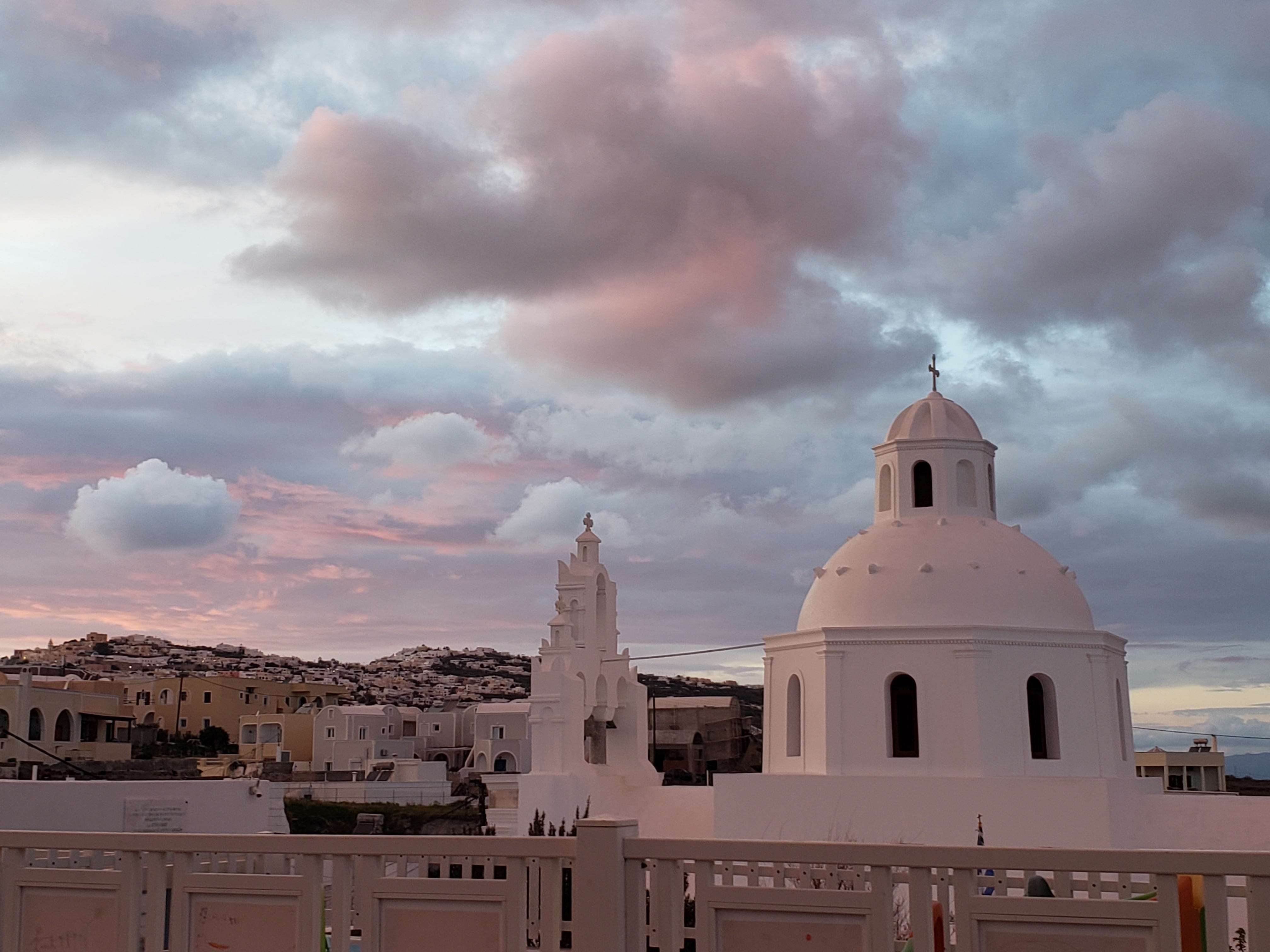
From the airport, we made our way to the place we’d call home for the next couple of days: Hotel Anna Pensione. Another small family-owned business — her son picked us up at the airport — this adorable hotel is located in the picturesque village of Karterados. Decorated in Greece's signature domed architecture and whitewashed palette, Karterados might not look like much at first, but as we soon discovered, it has its own charm. Anna’s was incredibly comfortable with free Wi-Fi, air conditioning, pristine, fluffy beds, and clean, crisp rooms, as well as an open-access dining room, so not a bad choice for a couple of budget travelers.
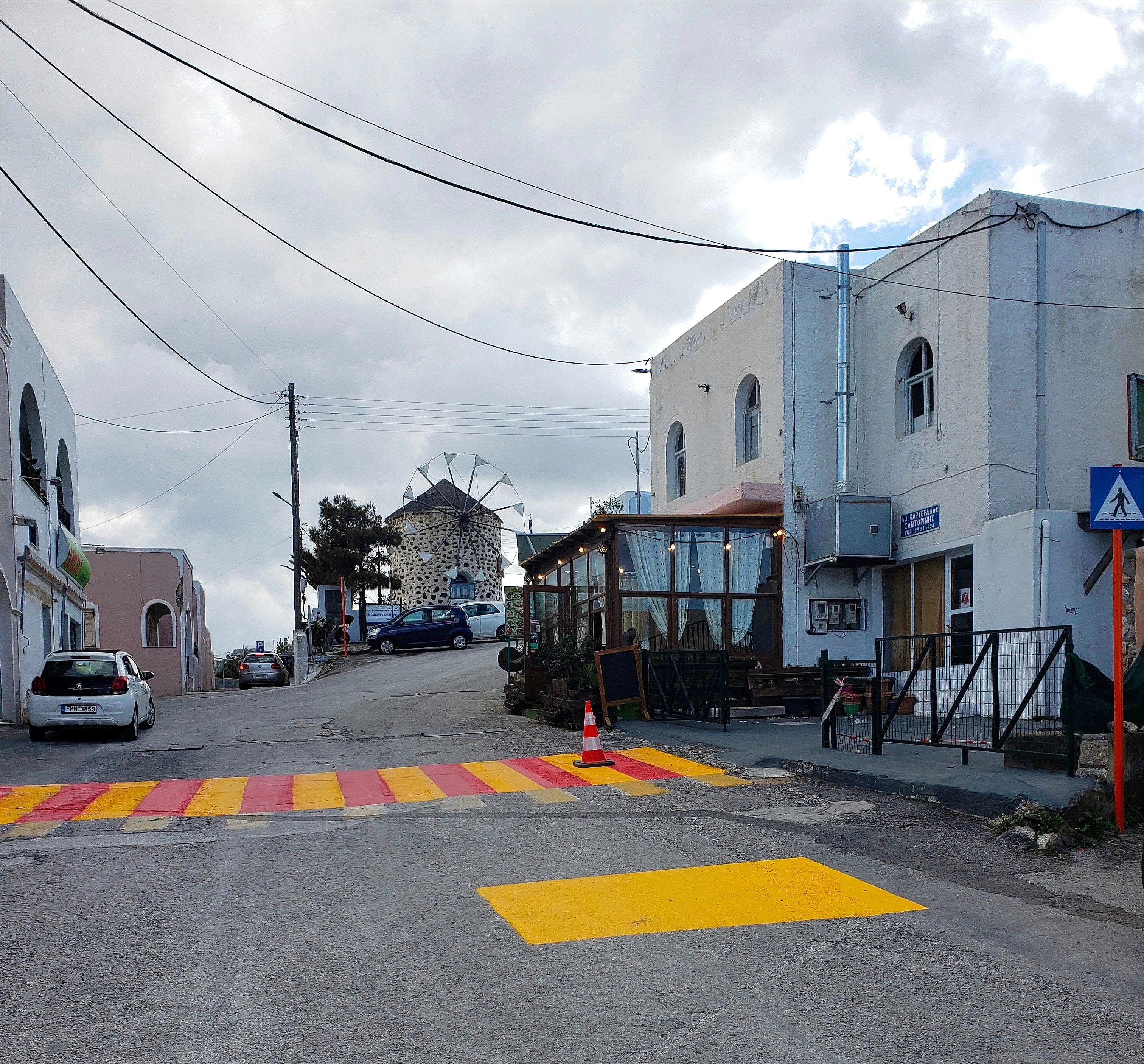
After we settled in, we went on the hunt for some lunch. Just up the road from the hotel, we came across a tiny cafe whose name was spelled out in Greek (of course). I call it the ‘Windmill Restaurant’ because it’s across the street from a stone windmill. The owner, an older gentleman with a graying head and beard, was very kind, and we managed to communicate with some basic English, no Greek, and lots of charades to get our points across. Somehow, it felt like traveling back in time a little. When the time came to order dessert, he suggested the traditional Greek Halva.
When I mentioned I was allergic to eggs (my own personal curse), he looked mystified, all at once sorry for me, and confused: “Who puts eggs in Halva?…no, no eggs,” he muttered, as he scuttled away to the kitchens. It was good enough for me!
Halva is a semolina pudding with raisins and nuts, with a dense, crumbly texture and a mild, sweet flavor. When I get to eat dessert, I’m not picky; if I can eat it, I’m just happy to be there and usually rate it 12/10. But it was honestly delicious. The pudding was warm, and I could taste the sweet spiciness of the cinnamon. Frankly, I loved it, but take from that what you will; it’s likely not for everyone.
Since it was still early in the day, we thought about staying in for dinner and made our way to a local grocery store to stock up for the night. Visiting grocery stores while traveling is always interesting, as I feel like it’s a personal view into another culture’s day-to-day; it’s also a fun exercise in picking things out that slightly resemble what you’re comfortable with but are just that different. Like when you’re learning another language, and you’re trying to parse the words for meaning. Crackers, chips, and cheese, with the familiar Strongbow cider, made for a satisfying aperitivo.
I will say, though, that eating in the hotel’s empty dining room like a picnic was one of the more memorable dinner times on that trip!

The Wrong Museum
The next day, we tackled our itinerary! Given the fact that we were originally supposed to visit with our class and professor, we made sure to visit everything we were going to see as a group. This included the archaeological museum in Santorini and the archaeological site of Akrotiri. We decided to visit the museum first as a way of getting our feet wet.
Listed only as ‘archaeological museum’ in our notes, we did a quick search via Maps and made our way to the aptly named Archaeological Museum of Thera. It should’ve been a no-brainer. However, after paying 2 euros at the entrance, we quickly walked in, excited for the day to start, excited to see all of those monumental wall paintings we had learned about in class, only to find that the “museum” was a single room with a random assemblage of artifacts…
There have been very few moments in my life when I wanted to burst out laughing maniacally out of nowhere, but this was one of those moments. As Liz and I looked at each other in amazement, we quietly, telepathically communicated and understood that this was not the museum our professor had in mind. Still…we did pay, and we didn’t want to be rude. So after a quick ‘turn about the room,’ stopping to look at artifacts with no labels, we thanked the ticket seller and proceeded to walk a (safe) distance away to burst into laughter!
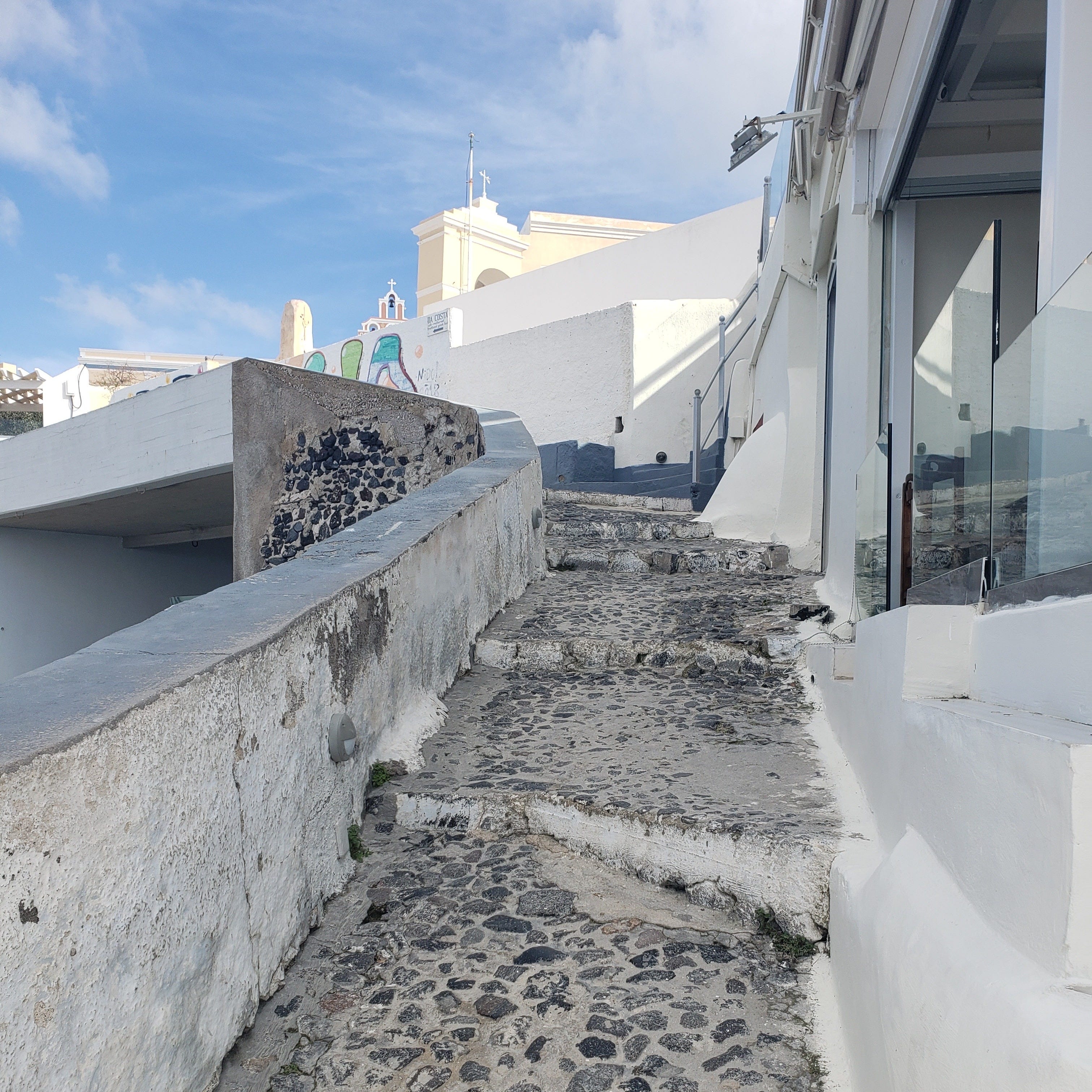
At the end of the day, it makes for a nice memory, and it was a sweet little gallery with some interesting pieces, but definitely not what we were looking for. On the bright side, the streets were empty of tourists. It was just us and sweeping vistas of the Aegean.


After searching for a while, we finally made our way to the actual museum we were supposed to visit: The Museum of Prehistoric Thera. The museum is a low white building with a wide staircase leading up to the entrance, arches, a bell tower, and topped with a white dome. It was built on top of the old Ypapanti Church, which was destroyed in the 1956 Amorgos earthquake (hence the bell tower). Once inside, though, it was immediately apparent this was where we needed to be. While not as well-lit or well-maintained as Heraklion’s museum, the exhibits looked well-cared for, with a logical layout, so I couldn’t complain.
A majority of the artifacts in the museum are from the ancient site of Akrotiri. Known as ‘the other Pompeii,’ Akrotiri is a Cycladic Bronze Age settlement that suffered a massive earthquake and was subsequently buried under the ash of a volcanic eruption during the 16th-17th century BCE, preserving a range of frescoes, architecture, and other artifacts. We would visit the site the very next day!


Among the artifacts, we saw the famous mural paintings: the so-called Papyrus plants, the Blue Monkeys, and the gorgeous so-called Saffron Gatherers, in their colorful garbs! Saffron, the spice worth its weight in gold, comes from the stems of the beautiful Crocus flower native to much of the Mediterranean. Painted pottery with marine life (whales, dolphins, flying fish), gleaming marble statues, and other artifacts abounded.
It was clear that they loved the sea and the natural world, as well as color! While it's easy to slip into the idea of a pristine, white antiquity, the ancient world was full of color, as can be seen in the vibrant blue, yellow, and orange dresses of the ladies in these paintings. This was the best part of traveling: seeing all these ancient works in person and getting to look at things that have conquered time itself. When we finally pulled ourselves away from the museum, we made our way down to the shore and dipped our feet into the Aegean Sea! It was freezing, and my toes turned red after a minute, but it was invigorating. Liz and I imagined ourselves looking out at the wine-dark expanse that had witnessed so many adventures in the ancient epics and drank it all in.
Akrotiri & the Red Beach
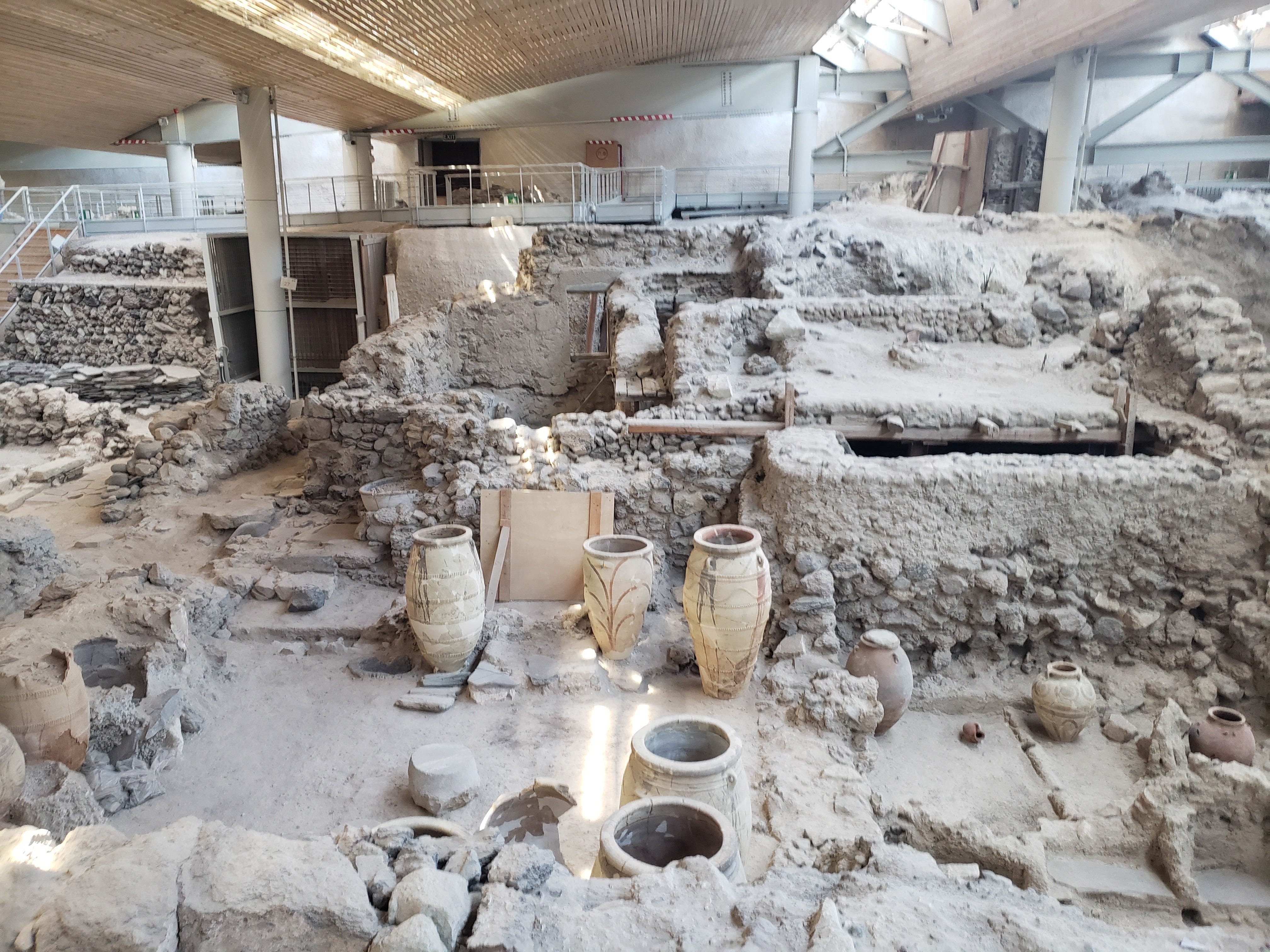
Akrotiri is an extremely interesting site in southern Santorini. Although all the artifacts and wall paintings were extracted and placed in the museum, the site is still very impressive in itself. It’s accessible only by car or by bus (take cash to pay for the bus ride once boarded), but once there, it’s worth it.
Not only is it massive and fascinating, but it’s also near the famous Red Beach. Known for its unique red-hued volcanic sand and stunning views, the Red Beach was truly unlike anything I had ever seen. The landscape was arid, with no vegetation besides small clusters of flowers and vegetation, and rugged. After spending a few hours at the Akrotiri site, we decided to explore the area while waiting for the bus.


We passed a beautiful whitewashed church against the stark red of the cliff face, which we learned later was the Orthodox Church of St. Nikolaos, and ended up climbing up the rough terrain in search of the beach. Turns out, we ended up climbing to a precarious point with no way to get down onto the beach itself.
We managed to obtain a nice view of it. A dramatic cliff of dark red stone, black pebbles, and soil with yellow flowers wrapped around this small beach and shoreline. Thinking back, that climb was not a very good idea and should not be taken lightly, considering that there were several moments I could see us tumbling off the cliff.
The Famous Oia
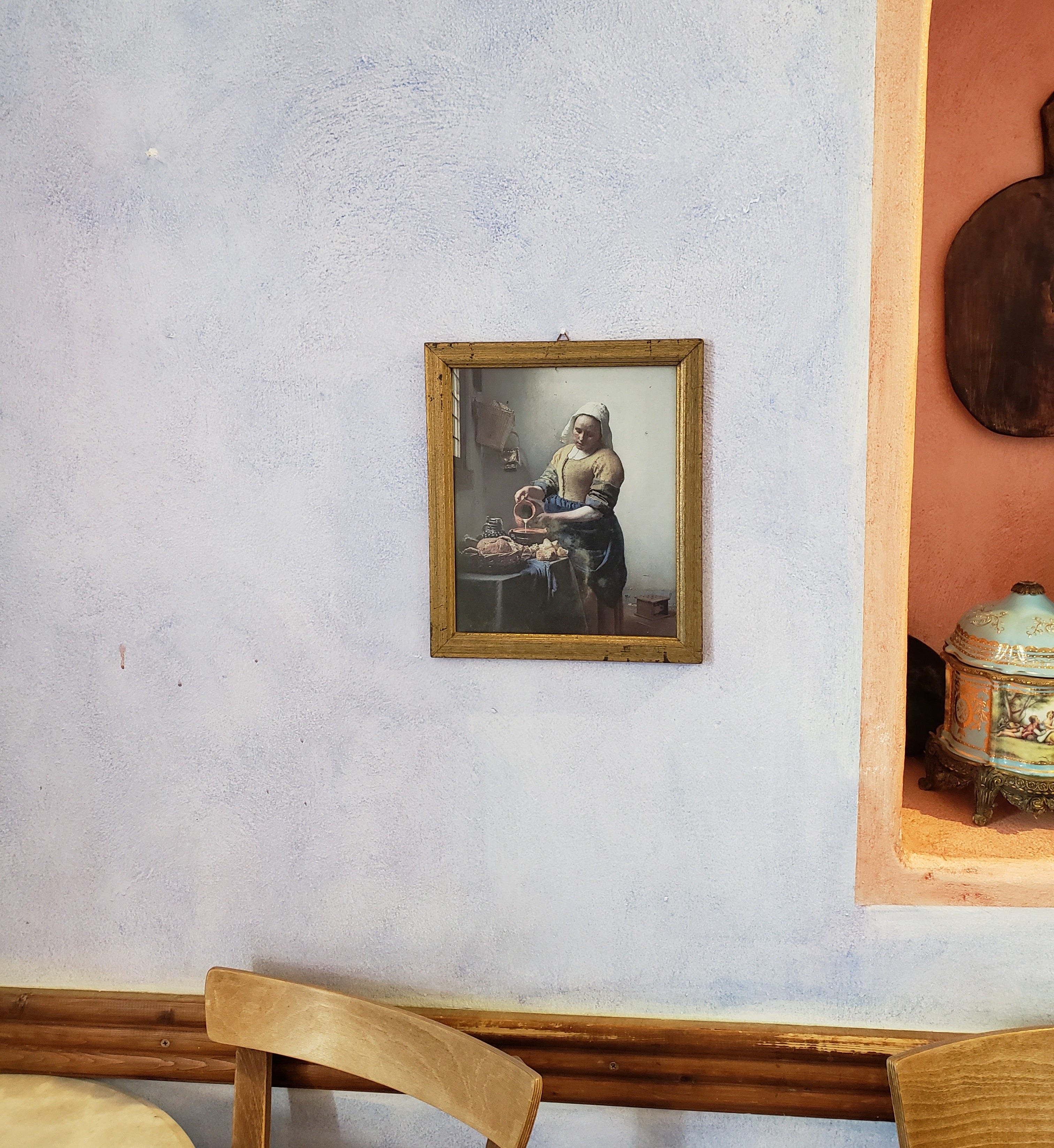
Our last day or so was spent at the famous, gorgeous white city of Oia, the poster child for every Greek holiday. One long, scenic bus ride later, and we were surrounded by pure white-washed buildings, topped with bright blue domes on a brilliantly sunny day. As an unexpected treat, it was absolutely empty. Every single nook and cranny of this gorgeous city was truly ours, and ours alone. By the time we arrived, it was lunchtime. So, we arrived at this adorable restaurant whose name I can’t remember – but I do remember the tiny Vermeer painting on the inside walls, a copy of The Milkmaid. Our hostess was incredibly kind and took us up to the rooftop, where we were greeted by the most spectacular view of the city and the coast.


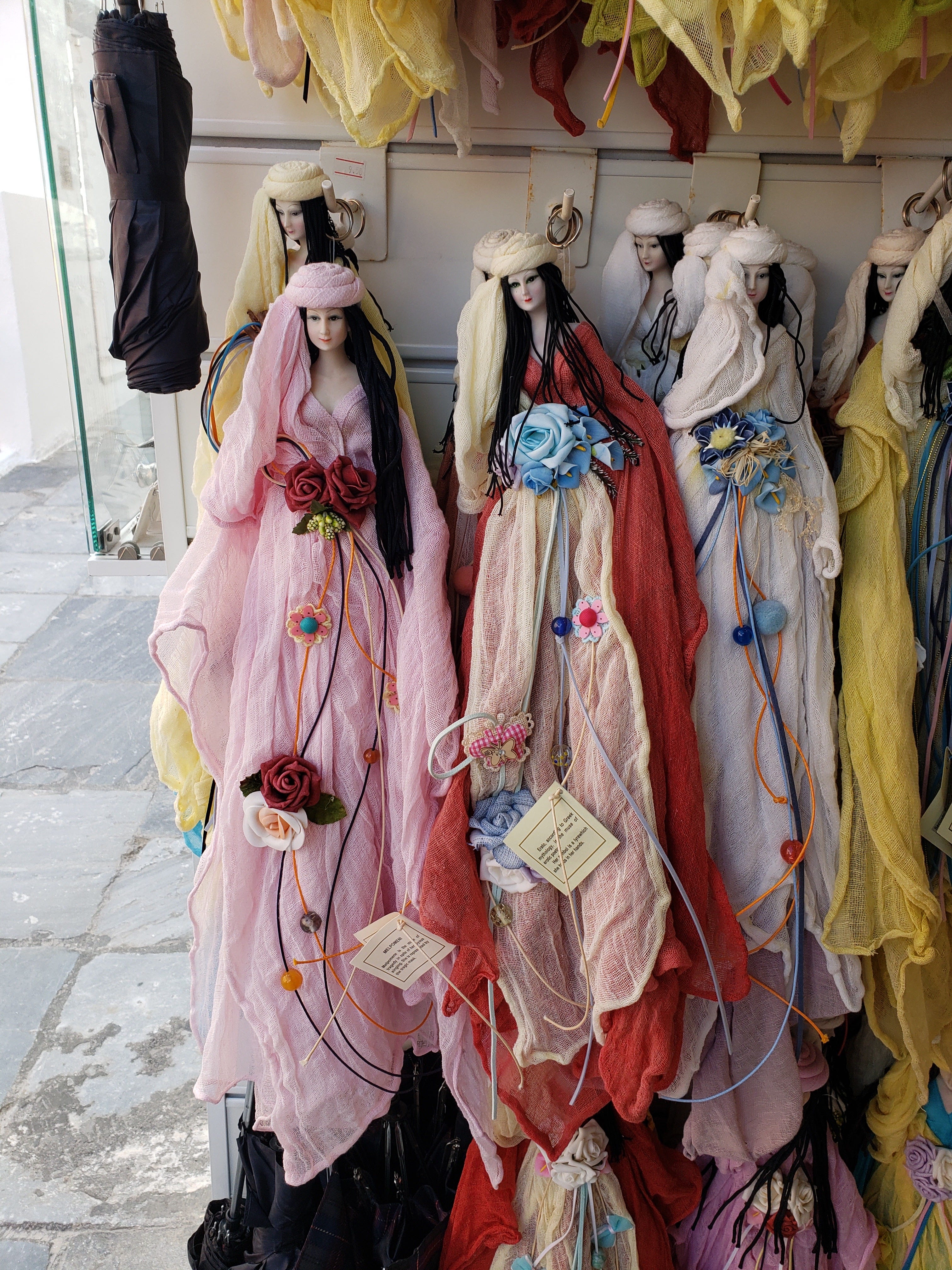
We ordered a series of sandwiches with chips and crisp cucumbers, and fed the kitties some pieces of ham. We ended the day sightseeing and doing some shopping! One shop was full of the Greek Blue Eye talismans, an ancient apotropaic symbol in the Mediterranean. I have always been fond of them as they are also present in Spain. The lovely shop owner—I remember her long red hair and large black-rimmed glasses vividly—gave us a quick history lesson about them in Greece. In the Greek Orthodox tradition, the Blue Eyes are said to represent the eyes of the Virgin Mary.
After picking up a gorgeous blue-silver scarf for my mom, some jewelry, and the all-important laptop sticker, we wandered around the city. A small sign was the only clue we received about how full this place gets during the summer:
“This is your holiday, but this is our home.”
I wondered how I would feel if I were living in a place that was advertised as a traveler’s dream. Would I be able to walk in my own home without bumping into tourists? Would I be able to tell the difference? In my hometown of Miami, you really can’t tell the tourists from the locals. Even in the touristy hot spots. But in this tiny hamlet on the island, it would be much more pronounced. For now, it was empty.
The Greek Orthodox Church of Panagia Platsani in the city is also incredibly beautiful. The first thing that catches your eye is the tall bell tower with 6 bells in three rows, stacked like a pyramidal shape, and topped with a Greek cross. Next is the large blue dome that crowns the building, and third, the large round dolphin mosaic in soft gray and white, situated right outside the church’s entrance. For a city that was so famous for its white/blue palette, Santorini is quite colorful! Salmon pink and bright mustard yellow hues jump out at you in between the quintessential Mediterranean colors.


It comes as no surprise that Oia, as touristically popular as it is, is absolutely worth it. The sweeping vistas of the sea and the iconic white buildings alone make the trek rewarding. It also reminded me that just because a place is popular does not mean that it is not worth visiting. The travel snobbery of ‘hidden gems’ and ‘getting out of touristy areas’ tends to highlight the implication that if a place is popular, it achieves the status of pedestrian and obvious.
And while overcrowding and high season numbers are indeed an (ongoing) problem, if you visit a place with intention and respect, you’re bound to have a good experience. Besides, no two visits to the same popular destination are ever the same.
Next and final stop on our Greek adventure, Athens!
I hope you follow along :)