

Let's talk about it: the discourse around Zendaya's gold earrings, & some thoughts on the film 🏺🌊
My 2-cents 📖


Disclaimer: this post is not meant to insult anyone involved in the discourse. To discuss and debate respectfully is one of the pillars of good academic work and
due diligence :)
It’s no secret that Cristopher Nolan’s highly-anticipated retelling of The Odyssey has stirred up its fair share of controversy. From the armor and costuming to the star-studded casting, everything seems to be wrapped up in a sense of doom and travesty, woven by the Fates. And that is putting it kindly, as Instagram and TikTok are overrun with historians, archaeologists, classicists, and lovers of the ancient world in general, who are screaming at each other over the validity of Nolan’s choices. Whether that’s over the “saddening loss” and “missed opportunity” of the ✨ Boar-tusk helmets, ✨ Helen’s love declaration for Paris, or the Greeks wearing pants.
I admit the last one is pretty bad; the Greeks thought wearing pants was for sissies. As one of humanity’s most defining works, I absolutely understand the protectiveness and the desire for adaptations to honor the work and the culture from which it comes. But I digress. Everyone is losing their minds, and to echo the wonderful essay on the same topic by cosi’s odyssey, which you can read here, everyone needs to calm down.
For the most part, I have kept my nose out of the mud. However, the latest controversy is about ancient jewelry, which is right up my alley, so on we go. At the London photocall for the film, Zendaya appeared on the red carpet, elegantly dressed in white and wearing two large, authentic ancient gold plaques, transformed into earrings by Glen Spiro (designed in 2018). While Law Roach's styling is brilliant and worthy of Athena (as always), it has called several things about the earrings into question. That word dreaded by collectors, dealers, and museums everywhere: Provenance.
How were the earrings acquired? From whom? Was it legal? How did they come to be here? The pieces in question are 2,500–3,000-year-old medallions, decorated with solar motifs radiating from a raised center and attributed to the Ziwiye treasure in northwestern Iran. Acquired by the prestigious Barron London and remounted by master designer Glen Spiro onto modern diamond and yellow gold earrings. They indeed stole the show. But their provenance and history — a non-negotiable aspect of collecting and dealing with artefacts and cultural heritage — are on shaky ground. Acquisition by “Undisclosed means” with a vague attribution to the Ziwiye treasure with little valid documentation has raised a ton of red flags. And rightly so.
An article published by the Penn Museum gives a summary of the hoard’s discovery:
In 1947, according to local reports, a shepherd made a chance discovery of a bronze or copper chest or coffin containing a treasure of gold washing out of the side of a small mountain in central Kurdistan, Iran. The local village of Ziwiye, not far from the town of Saqqiz, gave its name to this hoard which is sometimes also referred to as the Treasure of Saqqiz. Pieces soon made their way into the antique market after being divided, cut up, or melted down by the discoverers. A selection of it was acquired by the Archaeological Museum in Teheran where it is now displayed. Other pieces or parts of pieces are now to be seen in a number of major museums in Europe and America including our own University Museum (University Museum Bulletin, 1957).1
Wearing cultural heritage items with shaky provenance (at best) for a highly-publicized event is not a good look. Much less objects attributed to a hoard that was dug up, sold, and distributed illegally. Local villagers, clandestine excavators, and antiquities dealers all flocked to the site, which means there is no proper record of the objects, exactly how they were found, how they were used/worn, nor who they belonged to or what they were buried with. And, frankly, the art historian in me chuffs a little at the decontextualization of the plaques as modern jewelry. They were not originally used as earrings, but rather, “…small gold plaques [were] commonly seen as appliques for clothing. [or] incorporated into vessels.”2
Let me be clear: looting and trafficking are extremely harmful to the objects and to their country and people of origin. It doesn’t just fund illegal activity, but erases the object’s history. Due diligence is of the utmost importance in collecting and dealing, especially by museums and cultural institutions.


I am not going to pretend, however, that this wasn’t a beautiful look. I can’t help it! People can walk and chew gum at the same time. But these pieces go beyond my admiration. They are pieces of Iranian culture, heritage, identity, and indicators of something far beyond themselves. Jewelry is never just jewelry. Adornment means so much more, and proper stewardship is important.
That being said, nuance is desperately needed on several points in the current sea of criticism. These plaques are not evidence of recent looting, and should not be treated as such, as is echoed in an excellent piece by Lost in Jewels. In fact, other pieces of the same hoard are in the collections of other museums and institutions, and have been for years. Yet, there is no outcry for those other pieces [see, Inlay for a plate in the form of a hare].345 From what I see, the upset is not merely that the pieces are stolen/looted, but that they are being refashioned as modern jewelry (which is problematic), for the promotion of an American movie that no one likes: “just one more wrong thing about the Odyssey movie.”
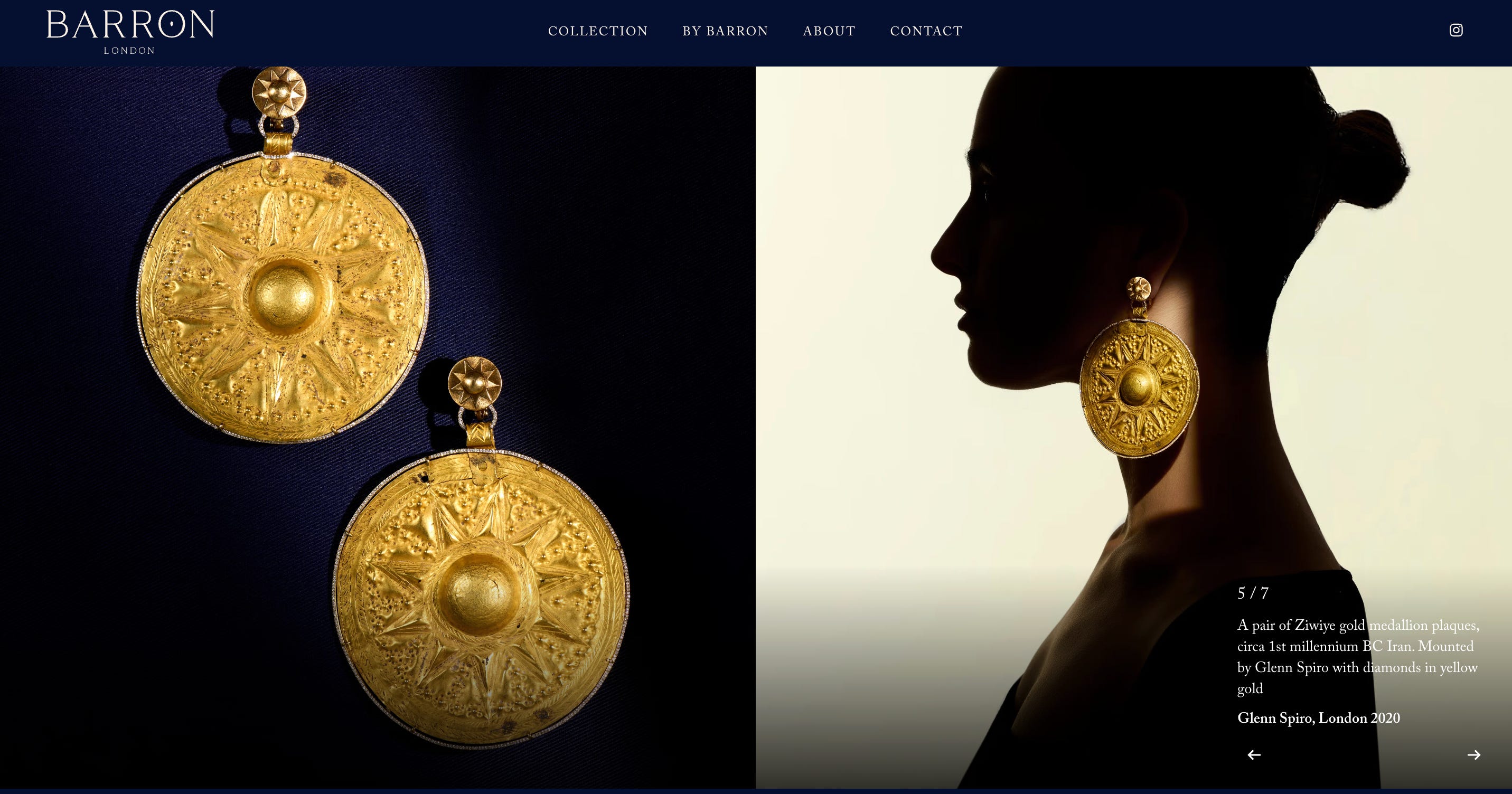
Again, this isn’t about defending Zendaya or the film. I have no fantasies or idolization of celebrities. They are just people, and we don’t know them. But context is important. In fact, we can’t be sure, despite Barron London’s listing, that the plaques are even from Ziwiye definitively:
In addition, many objects have been attributed to Ziwiye in subsequent decades that do not necessarily come from the site, and many forgeries have also been given this false provenience. In almost all cases it is hard to be certain that a given object really was found at Ziwiye … [such a thing] cannot be confirmed unless new information comes to light.6
There is a lot we don’t know. Regardless, I argue that the responsibility does not lie with the stylist or the celebrity. It falls to the artist, designer, buyer, and dealers. I am not suggesting that there wasn’t a lack of tact and due diligence, and a disconnect between intention and impact. There is a distinction between calling out something done in poor taste and actually having a hand in their theft. She did not excavate, buy, or secure them. Until proven otherwise, she just has the unfortunate status of being the person who wore them and (likely) trusted that she was being outfitted with something that was properly and legally acquired.
Asking questions about shady documentation is our responsibility (as writers, historians, art historians, classicists, archaeologists, lovers of antiquity, etc.) as stewards of heritage and culture. But I’m curious about the conversation quickly becoming about “Zendaya’s responsibilities.” Claims that she should be brought to justice abound, and yet, there is no, or little, anger directed toward Glen Spiro, who had the obligation to inquire where the materials in his collection came from back in 2018. The conversation is being steered in the wrong direction.
But it’s easy to blame her. She’s a public person, and “should’ve known better.” Maybe so. But some of the comments are just downright disturbing: “Sounds like Zendaya, her stylist, and her agent ought to be re-educated through ‘means undisclosed.’” “People who do that kind of thing should be 🤬🔪.”
👀 … For a society well-aware of the problem of violence against women, the so-called bearers of justice don’t seem to mind these types of comments. Although the red-carpet look does lend itself to the “fetishization of ancient culture” that has historically been committed by the elite, with thousands of antiquities having been stolen, I am overall jaded in how we socially deal with these things nowadays. There is no nuance, grace, consideration, or measured critical thinking, just righteous keyboard typing. Mostly the line: “it belongs in a museum!!” keeps popping up.
They should be in a museum, preferably in their country of origin. But museums don’t automatically make things better. Repatriation and proper provenance research take time and herculean efforts. The way museums source, buy, and display their objects and collections can bolster or erode public trust. As such, they have also formed a part of the commercialization of archaeology and cultural heritage (The Metropolitan Museum, Musée d’Orsay, and Nanjing Museum in China, among others, have all had similar disputes). While museums began as private “cabinets of curiosities,” modern museums operate under a public trust, meaning their collections are held for the benefit of society rather than for the profit of a private owner. As such, there are concerns that many institutions consider their public collections as financial assets rather than as cultural obligations.
Nolan is not destroying Homer anymore than Zendaya is destroying cultural civilization and heritage. Disrespecting it? Appropriating it? Perhaps, I acknowledge that. But disrespect can be remedied and rectified. To do something in poor taste is just that — poor taste. Something to be learned from and corrected. And I do hope the team has a loooong chat about it. I hope they take this as a learning opportunity to be more mindful in the future. I also, respectfully, partially disagree with many claiming that the intent was to disrespect people of color and ancient cultures by commodifying the artefacts.
It certainly came off that way. But I believe it’s more about being led/blinded by a vision without doing your homework. Symbolically, ideologically, culturally, it simply did not land well as a result.
My issue is not with condemning the act/idea of working with stolen objects. My issue is with the way this situation is being discussed. I actually think that it is a good reminder of the work that still needs to be done in existing collections. Jewelry reporters, historians, and writers need to ask questions about these pieces, as well as contemporary jewelry brands that use ancient materials such as coins. If you’re a buyer or collector, dig deep, research the piece you’re considering! Assume nothing, and question everything. And assimilate the idea that “being in a museum” does not make everything alright. In fact, the stakes are higher, in my opinion.
In writing this post, I have tried to be as informed and sincere as possible, and I do not begrudge others feeling differently. It is a contentious subject, filled with difficult questions to answer. We all want to do the right thing; we all also have a deep love for craftsmanship and the ancient world. One cannot ‘own’ or ‘buy’ millennia of human civilization and history. Hence, my dislike of this entire situation.
Some thoughts on the film
Nolan’s Odyssey is a retelling. The final word can only be had once the film is out and it has been seen (because of that, I am reserving my thoughts), especially on the point of Nolan disrespecting the source material, which many creators like LetsTalkaboutMythsBaby (wonderful podcast!) have claimed. Some points need to be addressed, though: people are quick to bring up Homer and being accurate to the myth when the ancient world was full of multiple versions and takes of the same stories.
On Medea, there are three different versions alone: written by Seneca, Euripides, and Apollonius of Rhodes. To say nothing of Ovid’s take in The Metamorphosis. On Iphigenia, whose famous sacrifice allows Agamemnon (her father) to sail for Troy, we have two differing accounts by Euripides and Aeschelyus. In short, there is no canon for mythology. The ancient world was full of what amounts to fan fiction. The version of the Iliad and the Odyssey we are familiar with is the surviving parts of an originally larger Epic cycle of eight ‘books.’ Moreover, the version by Homer that was copied down during the Middle Ages by monks was likely the most popular version of many versions of the Trojan War and Odysseus’ voyage home. Emily Wilson’s translation of the epic poem includes wonderful notes at the beginning on the Homeric Question (longstanding scholarly debate over the identity of the ancient Greek poet Homer). And she lays it out brilliantly!


Many people also conveniently forget (or don’t know about) the Telegony, which concludes the saga by following the final years and death of Odysseus, in which he leaves Penelope again, and ends up being killed by the son he had with the witch, Circe.
Nuance is needed. The film is going to be no more “accurate” than Hadestown, and I adore that musical, or Madeline Miller’s work (Circe is easily one of the best books I’ve ever read). Yes, the pants and the Age of Ultron armor for Menelaus are ridiculous, but so was the Colosseum filling up with sharks in Gladiator II, and people were less angry about that. Would it be nice to have more historical accuracy? Yes, absolutely! It would be nice to see some semblance of accuracy in clothing, architecture, and color, and I have my gripes (put Penelope in purple for Christ’s sake!). But it is also just a film, and another way in which these myths continue to be changed and transformed by the hands and cultures that they pass through. As posited by the brilliant Dr. Daisy Dunn below:
Hadestown is not exactly screaming ✨ ancient ✨ , and yet, it’s beloved for its genius. With good reason. It keeps the essence, the morals and themes of the story, the red thread intact. It does what it is supposed to do: tell the story of Orpheus and Eurydice, and expound on universal feelings of loss, love, grief, and trust. Myths and stories have often served as fluid vehicles for understanding human emotional patterns, and how the ancients made sense of the world around them and their own anxieties. What is epic for? Epics (poems written in the meter of dactylic hexameter) are how they memorialized the deeds of the great heroes. It is the preservation of memory. It is the opportunity to tell stories. And those stories do and did change.
Now you don’t have to like the film. You don’t have to like the retelling or any of the decisions he made while making it. Heaven knows I don’t. But it’s something worth thinking about. What is myth? And how did it work in an ancient context? And how do we keep interacting with it? The newest book on the subject is by Erica Stevenson (MoAn Inc.) The Odyssey Effect: How Homer’s Epic Poem Shaped the World should provide some interesting insights. It touches on this very point: that myths continue to evolve and change.
Robert H. Dyson, Jr., “Archaeological Scrap.” Expedition Magazine 5, no. 3 (May, 1963), Accessed July 15, 2026. https://www.penn.museum/sites/expedition/archaeological-scrap/.
The Metropolitan Museum of Art, “Inlay for a plate in the form of a hare,” Scythian, ca. 7th century BCE. Description: “Fragments of the plate were first reported in 1949 in Iran and said to be from the site of Ziwiye in the Zagros Mountains, in what is today Kurdistan Province, Iran. Many gold, silver, bronze, ivory, and ceramic objects have appeared on the antiquities market with the supposed provenance of Ziwiye, although there is no way to verify this identification.”
Ibid.
Penn Museum, “Dagger Hilt,” Near Eastern, Iran | Ziwiyeh. https://collections.penn.museum/collections/object/76513.
The Louvre, “plaquette,” Place of discovery: Région de Ziwiye. https://collections.louvre.fr/ark:/53355/cl010150703.
The Metropolitan Museum of Art, “Inlay for a plate in the form of a hare.”
There are a lot of Spiro pieces that incorporate the Baoulé jewellery. Actually anyone who works with rare stones would have a piece of the “civilization”. The same is true for a lot of objects beyond jewellery. I don’t see a straightforward path to identifying these items unless the source country pours significant resources into it. And it might result in a few collaborations but change on a larger scale requires facing some uncomfortable truths. What do you think?
Such an interesting article!